
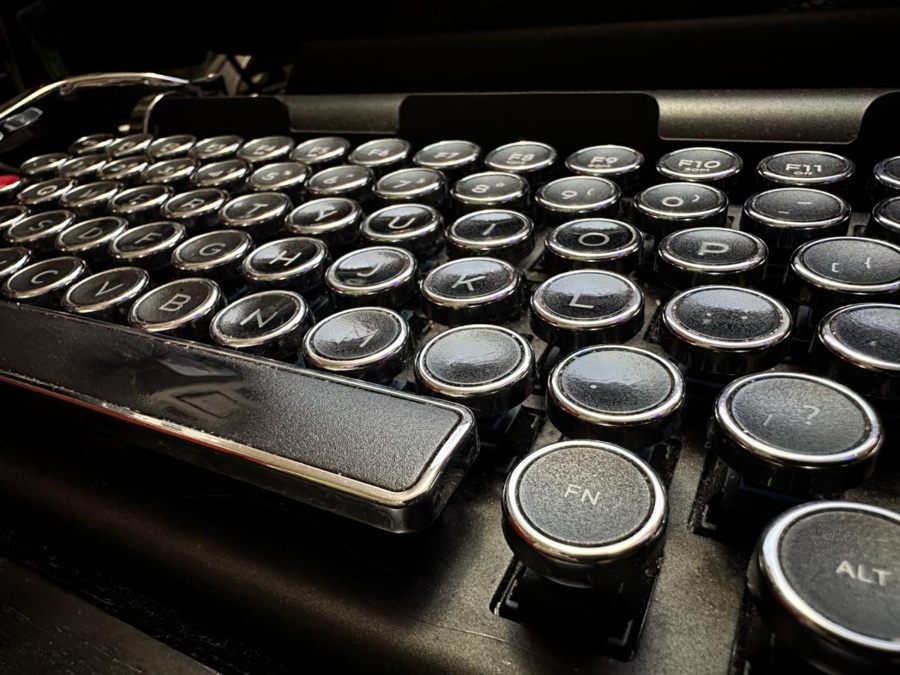
My computer keyboard looks like a typewriter. And I write books with it – all by my human self.
Post updated in August 2026.
Let me be absolutely clear: I trashed the original post I wrote here in 2023 and rewrote it in 2026. Because a lot has changed since AI seemed like just a curiosity.
Which seems like yesterday.
And this post will immediately be out of date given the way we’re hurtling into the future, so buckle up.
“Do you use AI?” This is the question being asked of, well, everyone right now. Especially writers. More on that in a minute.
My short answer: I do not use generative AI to write books or design book covers.
But because AI has permeated just about everything, sometimes I’m not even sure if I’m using it in everyday life. Are you? It’s the first result in search engines (though you can set Google to start without it). It’s integrated into apps to an absurd degree. Some helpful photo editing tools (such as those that de-noise images) may or may not be AI, and I appreciate those tools. (And using Photoshop in and of itself, or using a digital program like Procreate to draw on my iPad, is not equivalent to using AI, as some folks online seem to think.)
AI is also implemented in silly and unnecessary ways in just about everything.
No doubt it has its uses. I have occasionally consulted ChatGPT as kind of a search engine on steroids. And then I checked what it told me, because it makes things up.
If AI can help diagnose diseases or write software, that sounds good, right? Some writers and others are using it in innovative ways to analyze ads and write marketing copy.
But is it worth using all of our natural resources to make the future of AI possible? For instance, by 2030, greenhouse gases emitted by data centers will comprise about 40 percent of what the United States produces in a year, according to Morgan Stanley. (And yes, climate change is happening, folks.)
According to Cornell, unchecked AI use would consume water equivalent to the annual household usage of 6 million to 10 million Americans. A conversation of 20 to 50 questions with ChatGPT consumes half a liter of fresh water. And the power needs of data centers are flabbergasting. (Read more of the details and documentation for this information here.)
As an added extra bonus, AI is also making us more stupid.
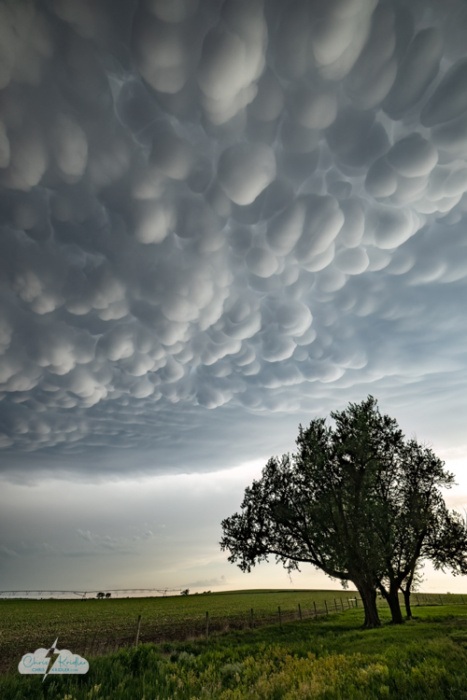
My real photo of a mammatus-filled sky on May 17 in Nebraska.
And I hate posting a real storm video and then seeing a laughable AI version with twenty rainbows and other fakery, with commenters exclaiming about how amazing nature is and the “creators” earning clicks and financial gain from their fraud.
When AI was a novelty — and before I truly understood the extent of how art and writing were scraped and stolen without creators’ permission to teach these models — I played with the Wombo Dream AI app. I enjoyed iterating my own ideas, created a few marketing images, made virtual “collector cards” for my characters, and simply had fun with it. I stopped using it once I learned more about how the work of creators was stolen and scraped to teach various AI models.
And now, along with 300,000 other writers, I’m a party to the Anthropic copyright lawsuit over its use of pirated books — including mine — to teach its AI.
There are good reasons people are upset about the prolific use of AI. But the dark side of the AI backlash is the sometimes ridiculous witch hunts that social media vigilantes and some press are waging against writers, using notoriously unreliable AI tools like Pangram. There’s a reason so many books are flagged as using significant amounts of AI content. It’s because THE AI MODELS TRAINED ON OUR BOOKS. And our websites, including this one.
There are so many questions about what artificial intelligence means to us now and what it will mean in the future. There are some terrifying projections, honestly. And seeing an Open AI agent escape its sandbox recently and hack another AI company, Hugging Face – blasting past law and convention in blind pursuit of an insignificant objective — might offer a preview of what sentient AIs will do to humans to achieve their goals.
I’m a techie kind of geek. I love great tools that work. But I worry that these tools have too much baggage for us to use them without drastic consequences unless we take stock, make them sustainable, and put up more guardrails.
This thought applies to a lot of things in life: Just because you can do something doesn’t mean you should.