
Q&A with Chris Kridler, author of the novels Funnel Vision, Tornado Pinball and Zap Bang
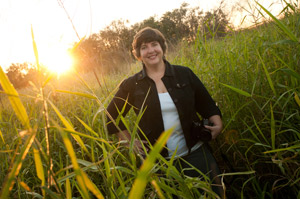
Chris Kridler chases storms every spring in Tornado Alley, along with lightning storms in Florida. Photo by Amanda Stratford, stratfordphotos.com
Brief bio: Chris Kridler is a writer, editor, photographer and storm chaser. She is the author of Funnel Vision, Tornado Pinball and Zap Bang, storm-chasing adventure novels in the Storm Seekers Series. She also writes romances and mysteries under a pen name. As a journalist, she’s covered a variety of topics, from space to lifestyles, and was a longtime columnist for Florida Today. Chris’s photographs have appeared in several magazines and books, including the covers of The Journal of Meteorology, the book Winderful, and the Wallace and Hobbs Atmospheric Science textbook. She was featured in Popular Photography. Her short film “Chasing Reality” won the best documentary award at the Melbourne Independent Filmmakers Festival in Florida in 2011; she won best animation in 2013 with “The Chase.” She has been interviewed in various media about her storm-chasing adventures. Learn more at ChrisKridler.com. SEE LONGER BIO
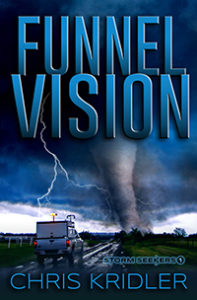
“Funnel Vision” is a storm-chasing adventure novel by Chris Kridler.
How did you first get involved with chasing storms?
I was always interested in weather and tornadoes. I realized in 1997 that there were actually storm-chasing tours, so I booked two weeks with Cloud 9 Tours and got hooked. I had never seen the massive storms with amazing structure like those I saw on the Plains. The next year, I chased for two weeks on my own and two more weeks with the tour. Every year since, I’ve gone back to Tornado Alley to chase storms in the spring, either on my own or with friends. I also chase lightning storms in Florida.
Are there many women who chase storms?
Our numbers are increasing, as are the numbers of chasers overall, but there are still far fewer women than men who chase storms. People chase storms for a lot of different reasons – I have scientific curiosity and an appreciation of their beauty, along with a love for the freedom of the road while following the whims of nature – but some chasers seem to be in it for the adrenaline or machismo. As the community grows, there’s a lot of debate about people’s motives, as fame has become a component for some chasers, too.
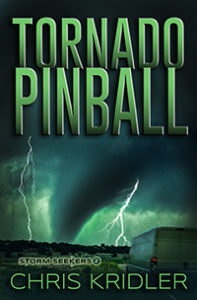
“Tornado Pinball” is a storm-chasing adventure and the sequel to “Funnel Vision,” by Chris Kridler.
Why did you write “Funnel Vision”?
“Funnel Vision” was the first novel I published, but the third I wrote. I’ve always been a writer, even before I was a storm chaser. The powerful allure of the storms for chasers, along with the chaos that goes along with them, was an attractive subject for a novel. I wanted to get into the heads of some of the people who chase storms and show a little of what they were thinking – and, you might say, what I am thinking when I chase storms, though I’m not a character in the novel. In the end, of course, chasers are just people, with all the hangups, drama, amorous inclinations and humorous outlooks that anyone else might have, even if they have this particular obsession. Ultimately, I wanted to tell an entertaining story. It crosses genres, with elements of action-adventure, humor and romance.
Where did the title come from?
While I worked at The Sun in Baltimore, I wrote an article in 1998 about my first chasing experience with a tour group. A clever editor came up with “Funnel Vision” to headline the article, and when I started writing the novel in the mid-2000s, it seemed like a perfect title to borrow.
Where does the sequel take the story?
In “Tornado Pinball,” the sequel to “Funnel Vision,” tornado researcher Jack Andreas returns as the reluctant consultant to a TV crew trying to execute the ultimate extreme storm-chasing stunt: getting a manned probe into a tornado. The story lets me explore the characters’ motivations, and it also lets me have fun with the media culture that surrounds storm chasing. Familiar characters return alongside new ones. The novel stands alone, though there are references to “Funnel Vision,” and Judy, who starred with Jack in the first novel, makes a brief appearance, too. It’s a true page-turner, and I think it would make a great movie. Read more about the story in this blog post.
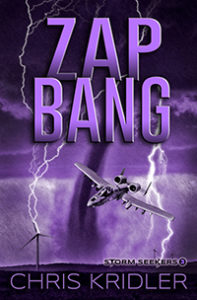
‘Zap Bang’ by Chris Kridler follows ‘Tornado Pinball’ in the Storm Seekers Series.
How does the third novel continue the story?
“Zap Bang” can also stand alone, but there are several recurring characters. Jack Andreas is recruited for a lightning research project, and he’s joined by a minor character from “Tornado Pinball”: Maribeth Lisbon, a pilot who steps up to fly a converted A-10 Warthog into supercells. There’s also a story line that features two characters familiar to readers of “Tornado Pinball”: adventurer Aurelius Zane, who’s down on his luck and about to undergo a journey he never would have expected, and Brad Treat, the onetime tour operator who’s just as much of a weasel as ever; together, they’re trying to get a young couple married in front of a tornado for a TV show. Their story allows me to poke more fun at the media culture storm chasing has become. Meanwhile, the main characters face deadly storms and their own tangled emotions as they try to complete their mission.
Why did you bring back the pilot who appears so briefly in “Tornado Pinball”?
I knew when I first wrote the character of Maribeth that she couldn’t appear just once. She’s an Iraq war veteran and a lifetime pilot who loves flying. In a way, she uses it as her escape. She’s strong, smart and tough, but under her cool facade, she’s dealing with loss and with her own vulnerability. She’s the perfect foil for Jack, who needs someone to challenge his cocky ways.
What is ‘Chasing Reality’?
“Chasing Reality” is a short documentary I produced about the realities of storm chasing. Much of what you see about chasing on TV is highly condensed and edited, leaving out most of the long drives, the dreary hotels, and the role of chasers’ cars as homes away from home. This short film shows what it’s really like, with a sense of humor and, of course, a few tornadoes. It won the Best Documentary award at the Melbourne Independent Filmmakers Festival in Melbourne, Florida, in 2011. See it here.
What is your favorite kind of weather to photograph?
A highly structured supercell in the beautiful light of a fading day is my favorite weather subject. Lightning is a bonus. These “perfect storms” are rare, but when you can capture a massive storm in a photograph that looks like a layer cake or UFO, you can almost sense its rotation and power. A unique setting can make all the difference, too; one of my favorite photos is of a lightning strike over the Grand Canal in Venice, Italy.
How do you determine where to go to find storms?
First, it’s important to be where the storms happen – in the spring, that’s Tornado Alley. Then, of course, you need to start your day within driving distance of the target, so you are always doing long-range and short-range forecasts. On a chase day, I look at a variety of data sources online and try to pick the best spot for initiation of rotating storms. As the day continues, a combination of live radar and satellite updates, thanks to cellular data, and strategic planning can help a chaser get into position. That said, there are a thousand ways to miss the ideal moment on the ideal storm, so luck is involved, too.
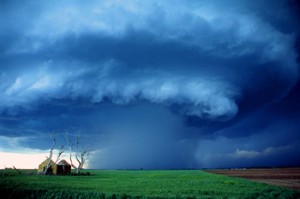
A rotating supercell in northern Kansas, 8 May 2001. Photo by Chris Kridler, ChrisKridler.com, SkyDiary.com
How do you stay safe during lightning storms and tornadoes?
While you are never a hundred percent safe when chasing storms, if you have an idea of how supercells behave, have a good view of the storm and are getting radar data to boot, you can stay relatively safe from tornadoes. Large hail is also a danger, and I’ve had a couple of cars remodeled thanks to hail. Sometimes it’s a matter of choosing between getting close and getting the great shot and staying farther away, though those shots can be nice, too. I am not one of those folks who thinks it’s a great idea to drive into a tornado. As for lightning, if you can hear thunder, you are in danger of being struck. I sometimes shoot lightning from within my car by placing the camera on a monopod clamped to the driver’s side window. The metal car can act to disperse the charge if it’s struck, though the open window still increases my risk. That said, I feel safer than I would outside with a tripod, though I do that, too, if the lightning isn’t too intense.
What’s the most dramatic storm you have chased?
I really have two answers to this question. In my early chase years, May 12, 2004, in Attica, Kansas, was an incredible day. My group saw three tornadoes. One we saw from its beginning as the funnel formed in a field. It was eerily calm. Because the tornado wasn’t destroying anything, it didn’t make that “freight train” sound you so often hear about. It sounded like a waterfall. As it gained power, it got closer and closer to us. We had to scoot up the road, and as we looked back to our west and filmed it, it destroyed a house as it crossed the road, just a quarter mile away from us. Big hail was falling, and another tornado was forming to our east, threatening to cut us off. We called a friend and asked him to try to get through to emergency officials – fortunately, the family in the house survived. We caught up to the next tornado, which became very large and started dropping small satellite tornadoes around the edges of the circulation. One dropped on the road right in front of us. That was the first time I ever thought about getting into a ditch. But it dissipated quickly, and we zoomed east and got out of the way.
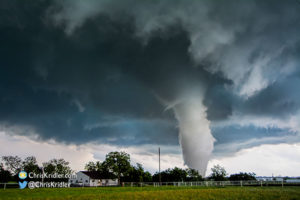
The Katie, Oklahoma, tornado of May 9, 2016. Photo by Chris Kridler
On May 9, 2016, I was chasing solo and got an amazing view of the Katie, Oklahoma, tornado, near Wynnewood, from its genesis to its rope-out stage. It was on the ground for about 25 minutes, and I was able to film it from one location. It was unusually photogenic and incredibly violent. It also passed quite close to me. To date, this has been the most intense experience I’ve had chasing storms.
What advice would you give someone who wants to chase storms?
Learn about strategy by partnering with other chasers or taking a tour. Other chasers appreciate enthusiasts, so if you build your reputation on an online chaser site, it may be easier to find a mentor. Most chasers won’t take you along just because you asked. And, of course, learn about weather and storms. If you have an understanding of how, where and why storms form, you are more likely to find the kind of storm you want to see while staying safe. And don’t believe everything you see on TV.
What web sites do you recommend for people interested in storm chasing?
Stormtrack.org is the most popular storm chaser site, with a large forum. Check out its FAQ. Facebook has also become a gathering place for chasers, but there’s a large noise factor there. Many chasers have their own sites, and some have detailed forecasts in their chase reports. Just reading these can teach you a lot. If you can afford it, take a storm chasing tour – there are many now, with some of the best and most established being Cloud 9 Tours and Tempest Tours.
Learn more about FUNNEL VISION, TORNADO PINBALL and ZAP BANG or buy the books